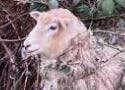
Freeing stuck sheep.
country neighbors & our obligations

Who knows how many bleats it took to wake me. The outraged bawl sounds — not weary, no, it doesn’t sound a bit like giving up — but as if it’s been at it for a good long while.
I go outside. The air is soft with the humidity that comes on early here in Virginia. Everything is very green, very lush — it gives a pulsing impression of growth.
“Lost lamb?” My husband is up already too, taking out the dogs, making coffee.
“Sounds stuck.” I am not chatty, mornings.
I have on tall farm boots and it’s a good thing too because the stretch of fence where the sheep is stuck is accessible only through a dense patch of poison ivy.
The sheep — no lamb, but a full-grown sheep — glares at me balefully. I have taken too long. It has gone from desperate to sullenly, and possibly aggressively, resentful.
Do sheep bite? Probably. This one looks interested.
There isn’t much nuance in a circumstance like this. I can’t persuade the silly thing to back up, to be patient and think about it calmly. It’s kind of a low-key Wittgenstein moment — If a lion could speak, we would not understand him, is what he thought, and probably so, because there is no way I’m getting anything into this sheep’s head. We are on non-intersecting planes, and only meet in this material moment, where I can help it, and it can bite me.
Or not.
It’s not my sheep. But when you live in the country ownership doesn’t matter in a situation like this. It’s livestock, it’s in trouble, and here I am.
My neighbor’s sheep stuck in my neighbor’s fence.
I have an obligation here, and it’s one I recognize and knew even before I pulled on my boots I’d accept. It’s an obligation of opportunity and … something else, something I don’t know a word for. There’s an obligation in being a neighbor in the country that is different to what I’ve felt elsewhere.
We’re lucky in our neighbors here. We’ve lived here almost twenty years and our kids and our neighbors’ kids, their ages years apart, still run like leggy hounds together, wordless and wild and almost family.
It’s a special kind of relationship, that between country neighbors, unselfconscious, practical, and possible because we hold something in common between us. What we share isn’t anything material — there’s no shared ownership of land or livestock — but we have all expressed, in the most healthily vehement way I know, that we value the same things. We’ve chosen the same kind of life.
Living in the country is optional unless you’re a working farmer, and the special concerns of country life are on no one’s shortlist of priority improvements. It’s expensive, especially now, because I have to drive everywhere and gas is costly. When something goes wrong it’s my problem — I can’t call the city if my septic tank overflows, as it has done once, disgustingly and expensively. Our tax base is small — rural county, not prosperous — and so our services are not bad but limited.
But it’s beautiful, neither quiet nor lonely, and full of change and color and contrast. And all of us along this little three mile country lane have chosen that — just that.
We’re not much alike in other ways. We’re not all white, or all Black. We don’t all have big gardens, or vote the same way, or go to the same church (or go to church, or temple, at all). Even these past couple years — maybe especially these past couple years — we don’t talk about politics, or the rest of the world, much. We talk about whether it’s rained enough to have a bonfire, about colleges and high schools, about dogs.
We’re neighbors, and here, that is being friends and also something else, not more but different.
So I look at this angry sheep. It glares back at me. My neighbor’s sheep doesn’t like me much.
And I pull on my long tough gloves, and work it free.